
“Can you bring me more Homi?” asked my mother when I called to let her know I was coming to visit her. My mother became an avid gardener in her middle age when her work of raising three daughters by herself was done, and a bit of free time became available to her. She spent her childhood in the foothills of one of the many mountains in Seoul, Korea. She would spend the day exploring the woods and streams behind her house until the evening and often got scolded for being late for dinner or soiling her new white socks with mud. I suppose gardening allowed her to reconnect with nature, albeit in the more modest scale of her Pennsylvania backyard. The tool she used almost exclusively for her garden was Homi.
Homi (호미) is a short-handled tool that can be used to dig, scrape, mound, and most notably, its upward curving blade allows prying up rocks embedded in the dirt. I routinely dig out football-sized rocks from my rocky soil using Homi. I am sure one with better grasp of physics will be able to describe the mechanics behind its effectiveness. It is also extremely effective in digging hard clay. For weeding, its sharp pointed end can be used to precisely dig out or scrape off weeds in tight spaces. It works great for planting in between roots of mature trees in woodland settings. Its light weight combined with the multifunctionality make it an ideal tool for this middle-aged woman. Homi seemed to have developed in ancient Korea as a farming tool, as it was found in Bronze- and Iron age archaeological sites (1). Countless women used it to work the rice paddies and family farms over many centuries.
My mother passed away a year ago. She planted two walnut seedlings a few days before her passing, no doubt using her trusted Homi. Now when I go out to my garden, the first thing I do is to grab my Homi and get reconnected with my mother– my history.
(1) https://en.wikipedia.org/wiki/Homi_(tool)

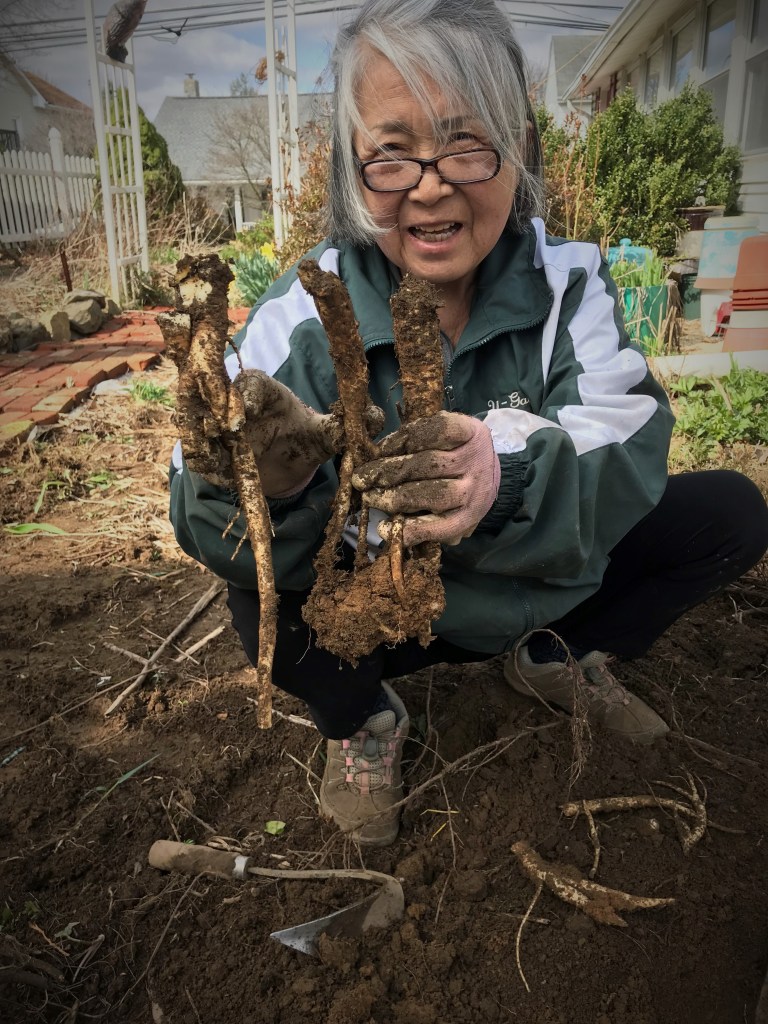
 Gardening with My Homi